Article Review – April 2026
Inside Fibrotic Fascia: The Cellular Drivers of Fibrosis
Review of:
Zhao, W., Li, Z., Ma, S., Chen, W., Wan, Z., Zhu, L., Li, L., & Wang, D. (2025). Identification of pro-fibrotic cellular subpopulations in fascia of gluteal muscle contracture using single-cell RNA sequencing. Journal of Translational Medicine, 23(1), 192. https://doi.org/10.1186/s12967-024-05889-y
Fibrosis is a common pathological process in many chronic diseases, characterised by tissue hardening due to excessive accumulation of extracellular matrix (ECM) components such as collagen and fibronectin. Yet even within myofascial disorders, research has largely focused on muscle fibrosis, often overlooking the contributions of the deep fascia and its pathophysiology.
The prevailing hypothesis has long suggested that resident fibroblasts differentiate into myofibroblasts, driving contracture through increased ECM deposition. While this model is supported across many tissues—and reinforced by observations in conditions such as Dupuytren’s disease—the cellular and molecular mechanisms of deep fascia fibrosis remain poorly understood. Addressing this gap represents a critical need.
This study, presented here by Dr. Wang, delivers a real tour de force by applying single-cell RNA sequencing (scRNA-seq) to fibrotic deep fascia in gluteal muscle contracture (GMC). This rapidly evolving technology—now widely used across fields from cancer biology to developmental science—allows us to “zoom in” on individual cells, uncovering cellular diversity and interactions that are otherwise hidden in bulk tissue analysis.
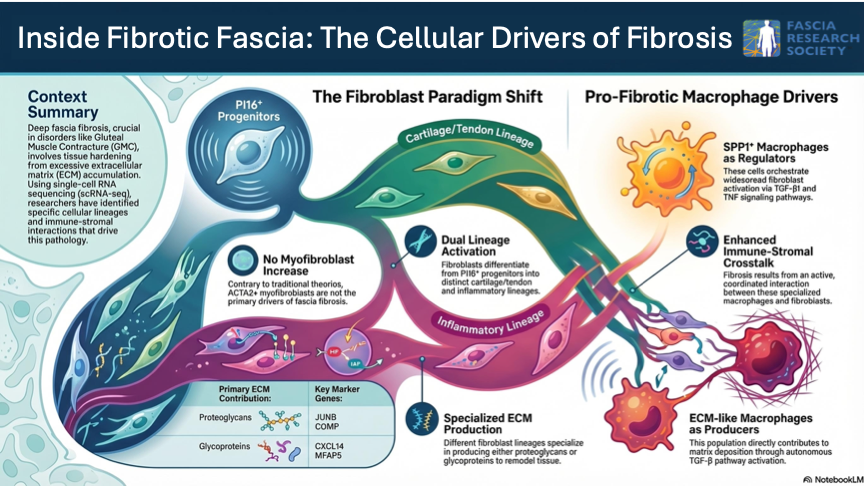
By mapping over 80,000 cells, the authors demonstrate that fascia fibrosis is not a passive accumulation of matrix, but rather an active, coordinated process driven by fibroblast activation and specialised macrophage populations. Strikingly, and contrary to conventional thinking, the number of myofibroblasts (ACTA2⁺) was not increased—challenging a central hypothesis in fibrosis biology.
Instead, in Dr Wang’s work, fibroblasts emerged as highly dynamic players. Four distinct subtypes arise from a PI16⁺ progenitor fibroblast along two main trajectories: a cartilage/tendon lineage and an inflammatory lineage. All contribute to ECM remodelling, not only through collagen production but also via a broad range of non-collagen ECM components. Notably, these lineages appear to specialise—cartilage/tendon fibroblasts producing proteoglycans, and inflammatory fibroblasts producing glycoproteins—highlighting a layered and stage-specific remodelling process.
Equally compelling is the role of macrophages. Two pro-fibrotic populations were identified: ECM-like macrophages, which directly contribute to matrix deposition via TGF-β signalling, and SPP1⁺ macrophages, which act as key regulators of fibroblast activation and ECM restructuring. These SPP1⁺ macrophages—already known to be implicated in fibrosis of the liver, lung, and heart—exhibit elevated TNF signalling and reinforce the concept that macrophages are not merely regulators, but active participants in fibrosis.